
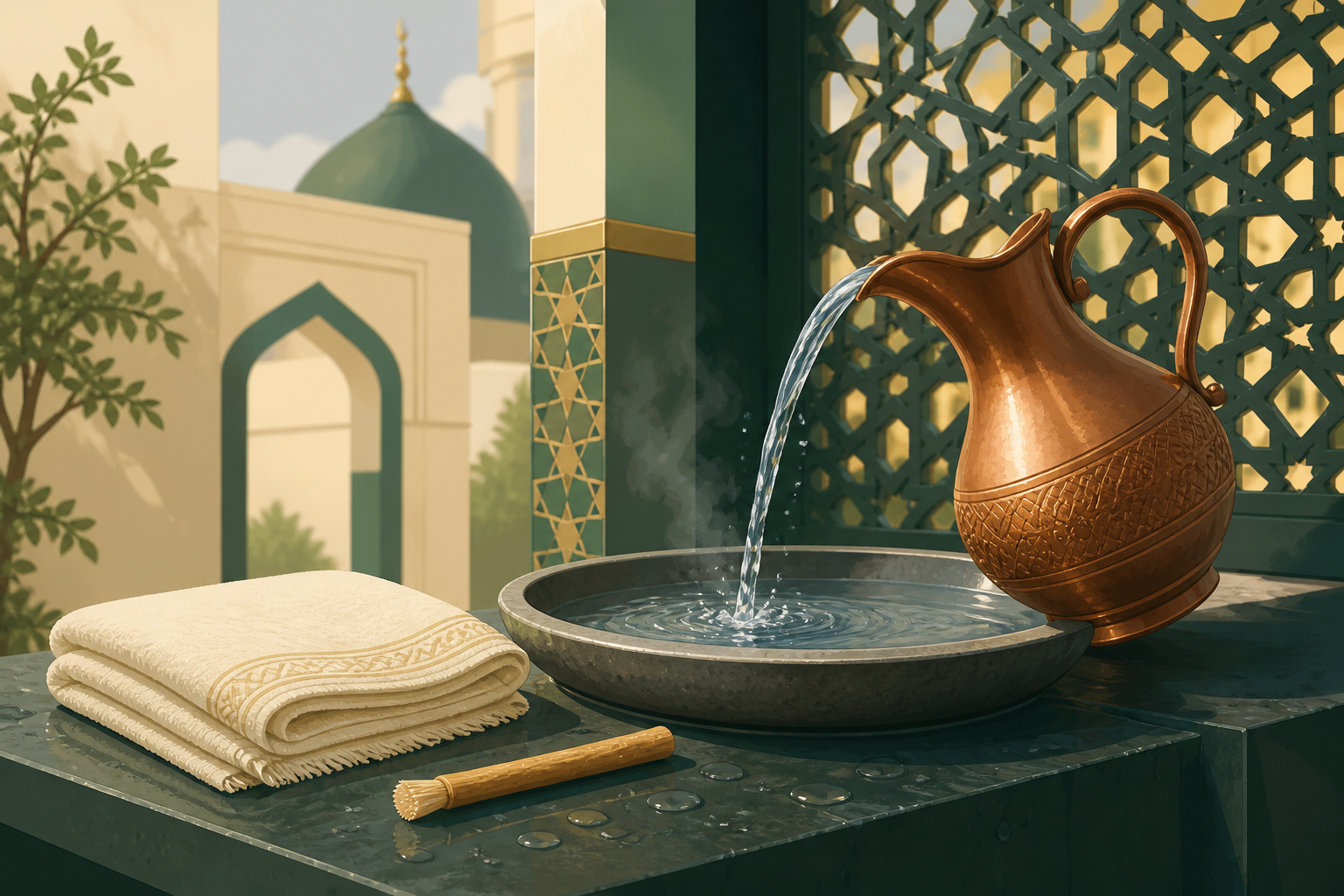
Wudu is the key to Salah. It is not a cultural wash and not only hygiene. It is an act of worship that Allah named in the Quran, that the Prophet (peace and blessings be upon him) taught by action, and that a Muslim needs for the prayer to be valid according to the well-known conditions of fiqh. This article explains what wudu is, how to make it, what breaks it in outline, ghusl in brief, and how to keep purification realistic at work and in travel. Schools differ on some details. Treat this as learning, then ask a qualified teacher to watch you once. It is not a personal fatwa.
Read this with the importance of Salah and the Prayer page. Purification without prayer is incomplete. Prayer without purification is not the salah the ummah was taught.
Why wudu matters
Allah says, in meaning, that when you rise to prayer you should wash the face, the arms to the elbows, wipe the head, and wash the feet to the ankles; and that if you are in a state of janabah you should purify yourselves (see Quran 5:6). The verse also allows tayammum with clean earth when water is unavailable or harmful. English here is a meaning of the verse, not a replacement for the Arabic Quran.
The Prophet (peace be upon him) said that purification is half of faith, as recorded in Sahih Muslim. He said that no salah is accepted without purification, as in Sahih Muslim. Wudu is therefore not a delay before the real worship. It is worship that prepares worship. It also trains the day: you stop, you wash, you intend, then you stand.
Intention and the name of Allah
Niyyah is in the heart: you know you are making wudu for salah. The majority do not require a loud formula. Saying Bismillah at the start is a known sunnah. If you forget, continue; do not restart ten times because of waswasah. See intention (niyyah).
How to make wudu: a practical sequence
The Quran lists four integrals: face, arms to the elbows, wiping the head, and feet to the ankles. The Sunnah fills in the Prophet’s method: washing the hands, rinsing the mouth and nose, washing each limb, starting with the right, and doing the actions in order.
- Intention. Say Bismillah if you remember.
- Wash the hands to the wrists.
- Rinse the mouth and nose.
- Wash the face, from the hairline to the chin and from ear to ear.
- Wash the right arm to and including the elbow, then the left.
- Wipe the head, including the ears as in the sunnah descriptions.
- Wash the right foot to and including the ankle, then the left, including between the toes.
He often washed three times. Once can suffice for the fard if the skin is fully covered with water, according to well-known fiqh. Do not waste water. He forbade wasting even at a river, as in the sunan. After wudu, the sunnah includes the shahadah and a dua asking to be among the repenters and the purified. Then pray if the time has entered.
What breaks wudu (outline)
The well-known breakers include anything exiting from the private parts, deep sleep that loosens control, and loss of reason. Madhhabs differ on touching the private part, touching a non-mahram, bleeding, and vomiting. Learn one school with a teacher. Doubt is not a breaker if you are sure you had wudu and then only maybe. Waswasah about wudu has destroyed the salah of many sincere people. If you are sick with this, do not repeat wudu without a clear reason.
Ghusl, in brief
Ghusl is a full purification required after janabah, and for women after menses and nifaas before salah, according to the known rules. The Quran mentions it in 5:6. The Sunnah describes pouring water over the whole body with intention, including the mouth and nose in the complete ghusl. If you are unsure after intimacy or a wet dream, ask; do not skip salah from embarrassment.
Tayammum
When there is no water, or using water would cause harm, Allah allowed tayammum with clean earth: wipe the face and hands as the verse and the Sunnah describe. This is a gift, not a laziness license because the bathroom is downstairs. Learn when it applies, especially if you are ill or travelling. See protecting Fajr.
Wudu at work, school, and in public
Map a clean sink. Carry a small towel. Wiping over khuffs or thick socks has conditions in the schools. If you use this concession, learn it properly. In public, make wudu with care and without harming others. Do not splash a walkway and call it piety.
Frequently asked questions
Does wudu break if I laugh?
Ordinary laughter does not break wudu in the well-known teaching of the majority. Laughing in salah has a different discussion.
Can I dry myself after wudu?
Yes, according to the common view. The issue is washing fully, not remaining dripping for show.
I have incontinence. What do I do?
This needs a personal fatwa. Many scholars give a concession to pray after cleaning and making wudu at the time of each prayer. Do not despair and leave salah. Ask.
Does nail polish block wudu?
Water must reach the skin for the washed parts. Barriers that stop water are a problem for those parts. Ask a teacher for medical dressings and dyes.
A habit for this week
Make wudu for every fard without rushing the elbows and heels. The Prophet (peace be upon him) warned about the heels in the sahih hadith, meaning to wash them fully. Pray two rak‘ahs after wudu when you can. Keep a bottle and towel at work.
Related: ihsan and daily duas.
Note: This article is for learning. It is not a personal fatwa. Follow a qualified local teacher. And Allah knows best.